 WonksAnonymous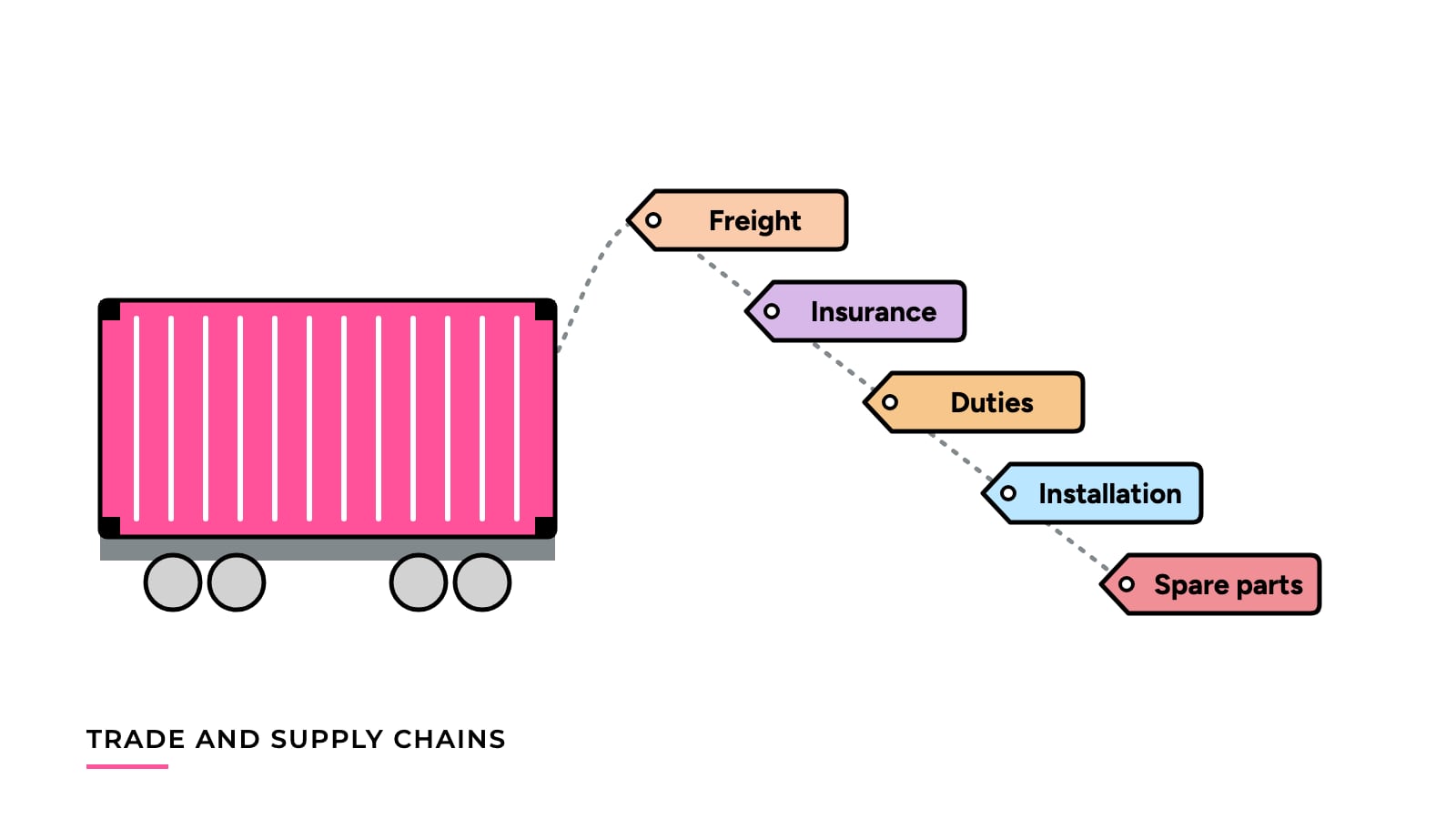
Imported Equipment Costs Beyond the Factory Price
A landed-and-running cost checklist for imported packaging machinery, showing which costs depend on the Incoterms rule and which never do.
When you buy a machine from another country, the factory price is the start of the cost, not the end. Freight, insurance, port charges, customs, delivery, installation and service all follow, and somebody pays for each. The decision question is how to compare an overseas quote with a local one on the same footing.
The short answer: list every cost from the supplier’s loading dock to normal production, then mark who pays it under the contract terms. Incoterms decide which party pays for which transport legs. They do not make any of the costs disappear, and they do not cover the costs of installation, compliance, spares or service at all.
What Incoterms decide
Incoterms are standard trade terms published by the International Chamber of Commerce (ICC). A rule in your contract, such as EXW, FOB, CIF, DAP or DDP, says which party arranges and pays for which legs of transport and where the risk of loss passes from seller to buyer. See the ICC Incoterms rules page for the rules themselves.
In general terms:
- EXW (Ex Works): the seller makes the goods available at its own premises. The buyer handles almost everything from there.
- FOB (Free on Board): the seller delivers the goods onto the vessel at the named port of shipment. It is for sea and inland waterway transport only.
- CIF (Cost, Insurance and Freight): the seller pays carriage and minimum insurance to the destination port, but risk passes when the goods are on board at origin. Also sea and inland waterway only.
- DAP (Delivered at Place): the seller delivers to the named destination, ready for unloading. The buyer handles import clearance and duties.
- DDP (Delivered Duty Paid): the seller also clears the goods for import and pays duties and taxes.
These are summaries. Details differ by rule and by edition, so confirm them against the current rules and your contract. A cost moves between buyer and seller depending on the term. A seller who quotes DDP has priced those legs into the invoice and may add a margin on top.
The cost list
Costs that move with the Incoterms rule:
- Export crating and packing. Wooden cases or sea-worthy wrapping for the machine.
- Origin inland freight and export handling. Trucking to the port, export clearance and loading.
- Main carriage. Sea or air freight.
- Cargo insurance. Cover against loss or damage in transit. Check who holds the risk at each point.
- Destination terminal and port charges. Handling, storage and documentation at the arrival port.
- Customs brokerage. The fee for preparing and filing the import entry.
- Import duties and taxes. These depend on the importing country, the tariff classification and the origin of the goods. This article gives no rates. Confirm them with a licensed customs broker or the customs authority.
- Destination inland delivery. Port to your site.
Costs that no Incoterms rule removes:
- Unloading and rigging at your site.
- Installation and commissioning by the supplier’s engineers. Travel, visas, accommodation, daily allowances, and waiting time if the site is not ready when they arrive.
- Local electrical and safety compliance. Supply voltage and frequency, local electrical and machine-safety requirements, and any modifications or certification.
- Spare parts stock sized for long lead times.
- Remote support across time zones. A fault at 9 a.m. at your plant may arrive at the supplier at night.
- Currency and payment terms. Deposit timing, exchange-rate movement between order and final payment, and bank charges.
- Warranty logistics. Who pays to ship a failed part, and how long the part takes to arrive.
The second group is the one buyers tend to price late. Our article on The True Installed Cost of Packaging Automation covers site preparation, line integration and ramp-up, which apply whether or not the machine crossed a border.
Tariff classification
Duty depends on how customs classifies the machine under the Harmonized System (HS). Packaging machinery is commonly examined under two subheadings: HS 8422.30, machinery for filling, closing, sealing, capsuling or labelling containers, and for aerating beverages (UN Statistics Division, 842230), and HS 8422.40, other packing or wrapping machinery (UN Statistics Division, 842240).
Those descriptions are from HS 2012. Later editions may differ, and national tariffs add further digits. The classification of a specific machine, including a multi-function line, must be confirmed by a customs broker or the customs authority. A wrong code can change the duty and cause delays at the border.
A worked example
Illustrative numbers, not a quote, benchmark or customer result. The duty and tax amount is assumed for illustration only, not a rate.
Take a machine with a factory price of $80,000, bought on FOB terms and shipped by sea. This extends the $80,000 machine from the installed-cost article, but it excludes the site preparation and line integration costs listed there.
| Line | Illustrative amount | Typically paid by (FOB) |
|---|---|---|
| Machine, factory price | $80,000 | Buyer (to seller) |
| Export crating and packing | $1,500 | Seller, in FOB price |
| Origin inland freight, export handling, loading | $2,000 | Seller, in FOB price |
| Sea freight | $4,500 | Buyer |
| Cargo insurance | $600 | Buyer |
| Destination terminal and port charges | $900 | Buyer |
| Customs brokerage | $500 | Buyer |
| Import duties and taxes | $6,000 | Buyer (assumed for illustration only, not a rate) |
| Destination inland delivery | $1,200 | Buyer |
| Subtotal, landed at site | $97,200 | |
| Unloading and rigging | $1,500 | Buyer |
| Supplier engineer days, 5 at $900 | $4,500 | Buyer |
| Engineer travel, visas, accommodation, allowances | $5,000 | Buyer |
| Waiting time allowance | $1,000 | Buyer |
| Local electrical and safety compliance | $3,000 | Buyer |
| Spare parts for long lead times | $4,000 | Buyer |
| Remote support | $800 | Buyer |
| Bank charges and currency allowance | $1,500 | Buyer |
| Warranty shipping reserve | $1,000 | Buyer |
| Total landed and running | $119,500 |
Check: the first group is $80,000 + $1,500 + $2,000 + $4,500 + $600 + $900 + $500 + $6,000 + $1,200 = $97,200. The second group is $1,500 + $4,500 + $5,000 + $1,000 + $3,000 + $4,000 + $800 + $1,500 + $1,000 = $22,300. And $97,200 + $22,300 = $119,500.
The same total under three terms
The overall cost stays $119,500. What changes is who invoices it. This ignores any margin the seller adds for taking on logistics, which can make a delivered price higher than the sum of its parts.
| Term | Paid to the seller | Buyer arranges and pays separately | Total |
|---|---|---|---|
| EXW | $80,000 (machine only) | $39,500 | $119,500 |
| FOB | $83,500 ($80,000 + $1,500 + $2,000) | $36,000 | $119,500 |
| DDP | $97,200 (through delivery, duties included) | $22,300 | $119,500 |
Under EXW the buyer separately pays $119,500 - $80,000 = $39,500. Under FOB, $119,500 - $83,500 = $36,000. Under DDP, $119,500 - $97,200 = $22,300. The comparison that matters is the bottom line, not the invoice from the seller.
DDP can reduce the buyer’s work and give a single price, but the buyer then relies on the seller’s choices about carrier, insurance and classification. EXW gives the buyer control and more tasks. Neither is cheaper by definition.
Supply continuity
An imported machine can be fine on day one and a problem in month eight. Plan before you sign.
- Lead times for wear parts. Ask for the lead time on sealing jaws, belts, knives, bearings and similar items, by air and by sea.
- Which parts to stock. Stock the parts that are cheap to hold and costly to wait for. Agree the list with the supplier and revisit it after the first year.
- Documentation. Ask for manuals, electrical and pneumatic diagrams and parts lists in a language your technicians read, and for the files to be editable.
- Local service options. Find out whether a local technician, distributor or independent engineer can service the machine, what they charge, and what the warranty says if they do.
Longer lead times raise the cost of downtime, which makes utilization and downtime cost more important; see How Equipment Utilization Changes Automation Payback.
When the conclusion changes
If the supplier has a local subsidiary or distributor who quotes delivered, installed and commissioned, many lines collapse into one price. Compare that price with the full landed list above. If you already hold an import account and a broker relationship, brokerage and port lines may be lower than assumed. If a machine ships by air because of an urgent start date, carriage will cost more than sea freight. For a trade-focused view of these choices, see the Trade and Supply Chains index.
Keep reading
- The True Installed Cost of Packaging Automation: the site, integration and ramp-up costs that apply to any machine.
- Automation Payback, ROI and TCO: What Each Metric Tells You: how to turn a total cost into a payback figure.
- How Equipment Utilization Changes Automation Payback: how run hours change the value of fast parts supply.
Assumptions and limits
- All dollar amounts are illustrative. The duty and tax figure is a placeholder and not a rate.
- Incoterms descriptions are general. Check the current rules and your contract.
- The model ignores financing, the time value of money, tax treatment of the purchase, and residual value.
- Currency movements are represented by a fixed allowance, not a forecast.
- Rules on classification, duty, product safety and electrical certification differ by country. Confirm them locally.
- It is for comparison. It does not replace financial, legal, customs, safety or engineering review.
Sources
- International Chamber of Commerce, Incoterms rules
- UN Statistics Division, HS 2012 classification 842230
- UN Statistics Division, HS 2012 classification 842240