 WonksAnonymous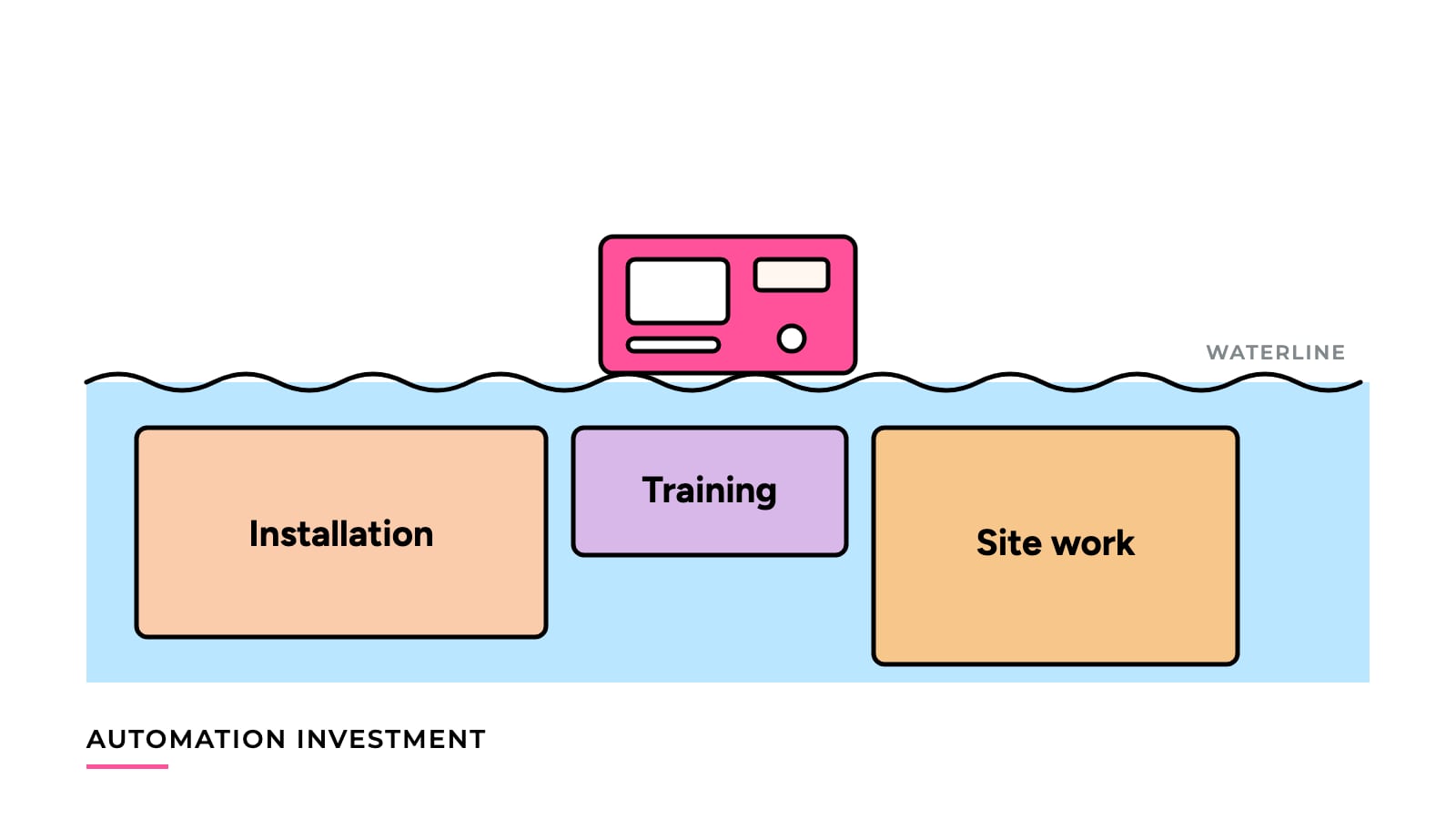
The True Installed Cost of Packaging Automation
A checklist of the costs beyond a packaging machine's price, a worked installed-cost example, and how to get suppliers to state scope and exclusions.
A machine price tells you what the supplier will invoice for the equipment. It does not tell you what it costs to get that equipment making sellable packs on your line. The decision question is which costs belong in the investment figure before you calculate payback.
The short answer: every cost you must pay to reach normal, accepted production belongs in the figure, whether the supplier invoices it or not. In the worked example below, an $80,000 machine becomes a $117,500 project, and payback moves from 40 months to about 59 months.
Six groups of cost
The costs beyond the machine price fall into six groups. Walk through all of them for each quote, even if you expect some to be zero.
Getting it there. Freight from the supplier to your site and the unloading and rigging at your dock. Heavy or tall machines may need a crane or specialist movers, and a delivery that arrives without them waits on the truck.
Getting the site ready. Floor preparation or anchoring, the electrical supply (new circuit, breaker, cabling, the right voltage and phase), compressed air at the right pressure and volume, and any water, drainage or extraction the process needs. Add space and layout changes: moving racks, relocating a conveyor, clearing a service aisle.
Making it fit the line. The machine rarely works alone. Integration covers the upstream feed and the downstream conveyors, checkweighers, metal detectors, coders and printers, case packers, and the controls link between them. Add change parts or format parts for each pack size beyond the first. Each extra size usually means tooling, and tooling has a price.
Making it safe and accepted. Guarding and a safety assessment, a factory acceptance test (FAT) with the travel it needs, a site acceptance test (SAT), and documentation. On regulated food or pharmaceutical lines, add validation work: protocols, material and contact-surface records, and the staff time to review them.
Getting it running. Supplier commissioning and start-up engineer days, operator and maintenance training, the packaging material and product consumed during setup and trials, and an initial set of spare parts.
The costs people forget. Production lost while the line is down for installation, the ramp-up period when output is below target, and internal project-management and engineering time. None of these appear on an invoice, but all of them are real.
A worked example
Illustrative numbers, not a quote, benchmark or customer result. The amounts are chosen to show the method. Do not read them as a typical share of machine price.
Assume a machine priced at $80,000 that replaces a manual packing step and feeds an existing conveyor.
| Cost line | Illustrative amount | Note |
|---|---|---|
| Machine price | $80,000 | Quoted equipment only |
| Freight | $2,000 | Supplier to site |
| Unloading and rigging | $1,500 | Forklift and riggers for one day |
| Floor preparation and anchoring | $800 | |
| Electrical supply | $1,800 | New circuit and cabling |
| Compressed air | $1,200 | Dryer and piping extension |
| Water or extraction | $0 | Not needed for this process |
| Layout changes | $1,700 | Move racks, clear a service aisle |
| Conveyor integration | $3,500 | Infeed and discharge conveyors |
| Checkweigher and coder interface | $1,500 | Brackets, signals, setup |
| Controls integration | $1,200 | Line stop and fault signals |
| Change parts for two extra pack sizes | $2,300 | Tooling per format |
| Guarding and safety assessment | $1,200 | |
| FAT travel | $1,300 | Two people, supplier’s plant |
| SAT | $500 | Internal time and test material |
| Documentation and validation | $1,000 | Records and review time |
| Commissioning engineer, 5 days | $5,000 | At $1,000 per day |
| Training | $1,200 | Operators and maintenance |
| Material consumed in setup and trials | $1,300 | Film, product, rejected packs |
| Initial spare parts | $1,500 | |
| Lost production during installation | $1,500 | One short stop of the existing line |
| Ramp-up shortfall | $2,500 | Output below target for the first weeks |
| Internal project and engineering time | $3,000 | Staff hours charged to the project |
| Total installed cost | $117,500 |
The non-machine lines add up in stages: getting it there $3,500; site $5,500; fit to the line $8,500; safe and accepted $4,000; running $9,000; forgotten costs $7,000. Together they are $37,500, and $80,000 + $37,500 = $117,500.
How it changes payback
The simple formula from Automation Payback, ROI and TCO is:
Payback (years) = Investment / Annual net cash benefit
Payback (months) = Payback (years) x 12
Suppose the machine saves a net $24,000 a year after operating costs. On machine price alone:
$80,000 / $24,000 = 3.33 years = 40 months
On installed cost:
$117,500 / $24,000 = 4.90 years = 58.75 months (about 59)
The gap is almost 19 months. Machine price alone flatters the project because it counts the full benefit but only part of the investment. A project that looks like a three-year payback to the board becomes a five-year payback on the same savings. Whether that still clears your hurdle depends on your own standards, and it should be decided before the purchase, not after the invoices arrive.
Benefit assumptions carry their own risk. A machine only delivers its annual benefit if the line around it can use the speed; see Why Faster Machines Do Not Always Increase Line Output. It also matters how many hours the machine actually runs, which is the subject of How Equipment Utilization Changes Automation Payback.
How to read a quote
The aim is a quote that states what you are buying in the same terms for every supplier. Ask each one for the following in writing.
- Scope. What is included in the price: the machine, the guarding, the controls, the tooling for which pack sizes, the documentation.
- Exclusions. What is explicitly not included. Silence is not an answer; ask for the list.
- Who supplies what. Freight, unloading, utilities connections, foundations, conveyors, and interfaces to existing equipment. Name the party for each.
- What acceptance means. The test, the sample, the speed and reject rate that count as passing, and what happens if the machine fails.
- What the warranty covers. Parts, labor, travel, the start date, and who pays to ship a failed part.
- Commissioning days included. How many engineer days, what happens when they run out, and the day rate for extra days.
Then compare quotes on the same scope. A lower machine price with fewer commissioning days, no change parts and your own freight is not cheaper. Put each quote into the same cost table and add the lines the supplier left out, using your best estimate and marking it as an estimate.
When some costs are zero
Not every project carries every line. Replacing a machine like-for-like on an existing line can remove most integration, layout and utility costs, because the connections already exist. In-house fitters and electricians reduce the outside labor, though their time is still a cost if it displaces other work. A supplier that delivers on its own truck, or a machine that ships on a skid with a standard plug, removes rigging and electrical work.
Be careful with the zeros that depend on timing. If the line can be installed over a planned shutdown, lost production may be nil. If it cannot, it may be the largest line in the table. A line is only zero if you can say why.
Checklist before approval
- Every group of cost has a number or a written reason it is zero.
- The quote lists exclusions, and each exclusion has an owner and an estimate.
- Commissioning days, FAT and SAT are in the scope.
- Change parts are priced for every pack size you plan to run.
- Imported equipment has its own additional lines: see Imported Equipment Costs Beyond the Factory Price.
- Payback is calculated on installed cost, with the machine-price-only figure shown beside it for comparison.
Keep reading
- Automation Payback, ROI and TCO: What Each Metric Tells You: the formulas behind the payback comparison above.
- Imported Equipment Costs Beyond the Factory Price: the extra transport, duty and service costs when the machine crosses a border.
- How Equipment Utilization Changes Automation Payback: how run hours change the benefit side of the same calculation.
Assumptions and limits
- All dollar amounts are illustrative and chosen for the example. They are not a quote, a benchmark or a typical share of machine price, and no rule of proportion is implied.
- The payback figures ignore taxes, financing, the time value of money, depreciation and residual value.
- The $24,000 annual net cash benefit is an assumption. It is held constant and starts on day one. The ramp-up shortfall is counted once, as a cost in the table, not again as a lower benefit.
- Regulated lines, unusual sites and imported equipment add lines this table does not cover.
- The model is for comparison. It does not replace financial, legal, safety or engineering review.